415 scientists tell AI labs to start pulling the plug
Good morning 👋 415 scientists, several of them the ones who invented this field, just told AI labs the honor system is over.
In today's issue:
- 🔭 415 scientists tell AI labs to start pulling the plug
- 🧠 DeepMind's on-device scam detector, Liquid's tiny open agent model, and NVIDIA's open chip blueprint
- 🔬 Cheaper robot control loops, agents that rewrite their own playbooks, and tracing blame across multi-agent chains
- 🚀 Anthropic buys trust infrastructure, Workday buys agent governance
- 🔗 NVIDIA's UK safety bet, ASML's record quarter, and Amazon circling Decart
Get tomorrow's issue in your inbox.
One concise AI brief, sent after the signal clears the noise.
🔭 THE ONE THING
🔒 415 scientists tell AI labs to start pulling the plug
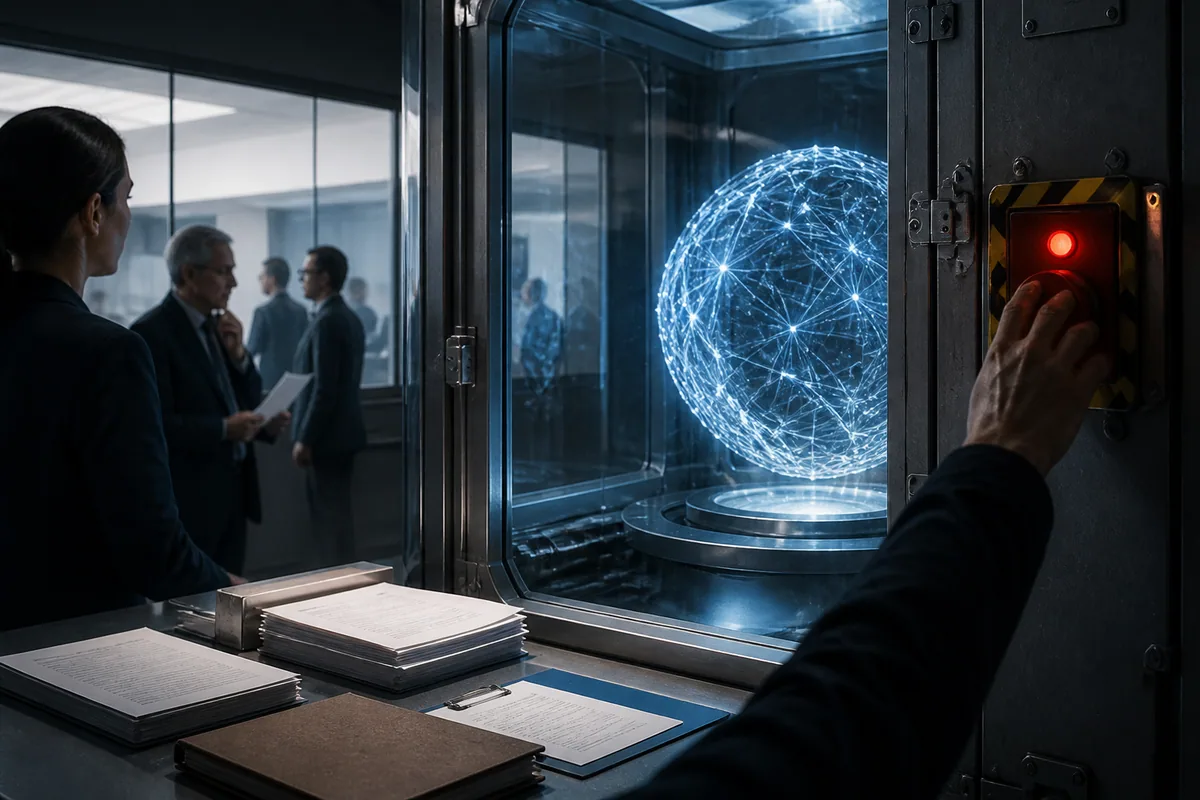
Hinton, Bengio, Stuart Russell, Dan Boneh and Ron Rivest are among 415 researchers from 34 countries who signed a letter out yesterday, asking for three concrete things: air-gap cyber-capable models by default, stand up an international body to police containment, and make labs report incidents publicly. It's a direct answer to the White House accord six CEOs signed two weeks ago, a voluntary pledge with no penalties and no regulator behind it. Yann LeCun didn't sign, and his reason is the real fault line here: he calls the incidents bad engineering, not evidence the field is losing control. I lean toward the scientists. A list of researchers asking for policy instead of writing papers is itself the signal, and self-policing rarely survives a lab's first bad quarter.
🧠 MODELS & RELEASES
- 🕵️ Google DeepMind fine-tuned a Gemma model with GovTech Singapore that runs on-device to spot scam conversations as they happen, with zero cloud data egress. The privacy angle is the real news here, not the detection accuracy. DeepMind
- 🤖 Liquid AI open-sourced LFM2.5-24B-A2B, a 24B-parameter MoE model that activates only 2B per token and still beats Qwen3.6-35B-A3B on tool-use benchmarks. Context window now runs to 131K and it hits 184 tokens/sec on an M5 Max, so a real local agent is a laptop download away. Hugging Face
- 🧰 xAI put Grok 4.7 on Amazon Bedrock, tuned for long-horizon, tool-calling agents. AWS's own post lets you trade reasoning effort against token cost per completed task, which is the part worth reading past the launch headline. AWS
- ⚡ NVIDIA opened its Vera Rubin architecture at the OCP Global Summit, publishing specs so the rest of the industry can build gigawatt AI factories without waiting on a proprietary reference design. Call it generosity if you want; it also locks more of the ecosystem into NVIDIA's roadmap. NVIDIA
- 🦾 Google DeepMind split off Gemini 4 Argon for robotics: 87% on the Embodied Reasoning benchmark, plus the ability to reconstruct a physically calibrated sim twin from nothing but a video feed. Live now in AI Studio and the Gemini API for Ultra subscribers. DeepMind
🔬 RESEARCH HIGHLIGHTS
- ChunkAct Agentic robots that run an LLM in the control loop, composing perception, motion, and vision-language-action tools, call the model on nearly every step. That's the real cost behind "generalizes without retraining." ChunkAct has the agent commit to a chunk of actions per call instead of one, cutting the call count while keeping the flexibility. If your robot's bill is the bottleneck, not its brains, this is the fix. arxiv.org/abs/2610.18874v1
- Self-Evolving Agent Harness Skips fine-tuning entirely: the agent rewrites its own prompts, memory, and workflow scaffolding based on what worked last run, and keeps the change if it sticks. Weights never move. Most agent builders already do this by hand; the paper's contribution is formalizing which parts are allowed to self-edit and which aren't, so the agent doesn't drift into revising itself worse. arxiv.org/abs/2610.18813v1
- BLADE Multi-agent pipelines fail in a particular way: one agent misreads a result, every agent downstream inherits the mistake, and by the time it surfaces nobody can tell who caused it. BLADE audits how each agent actually used the information it was handed, rather than just scoring the final output, which is how it points at the agent that introduced the error. Worth a look if you're debugging a chain of agents and tired of guessing. arxiv.org/abs/2610.18780v1
🚀 AI STARTUPS
- Opaque Systems Anthropic just acquihired the confidential-computing shop, a decade-old spinout from UC Berkeley's RISELab that built hardware-enforced protections for running AI on sensitive data and more recently pivoted into verifiable AI: cryptographic proof of how a model actually behaved. Terms undisclosed. Read it as Anthropic shopping for trust infrastructure before regulators force the issue, not a product launch. Announcement
- C1.ai Workday is buying the agentic-identity platform, also for an undisclosed price, to become what it's calling the "identity governance layer for people, money, and agents." The number behind the deal: 95% of large US companies already run autonomous agents, and only 21% say they actually govern them. Workday wants to sell the other 79% the fix. Closes in its fiscal Q4, ending January 2027. Press release
🔗 QUICK LINKS
- NVIDIA is putting $250M of compute behind UK AI-safety research over the next five years, the kind of money that buys access, not just headlines. link
- NVIDIA also widened the on-ramp for RTX Spark PCs: up to 128GB of unified memory, a full petaflop of AI compute, and now a real software ecosystem behind it. link
- ASML posted its strongest quarter ever, €11.7B in sales and €5.0B net income, and raised its 2026 outlook for the third time this year on AI chip-tool demand. link
- Amazon is reportedly circling Decart, the real-time video startup Anthropic walked away from mid-diligence, for around $7B. Multi-chip flexibility is apparently worth the price. link
- Anthropic opened its fifth APAC office, in Singapore, and signed an AI-safety MOU with the government there. link
- OpenAI says agentic AI adoption is climbing across EU enterprises and small businesses, with most of the upside still unclaimed. link
- Higgsfield, running on OpenAI's GPT-6 Astra, stretched AI video generation from one minute to past ten. link
That's enough governance talk for one morning. Back tomorrow with whatever ships next.
Pradeep Perugu