Huang and Nadella make the Windows desktop the AI agent's home
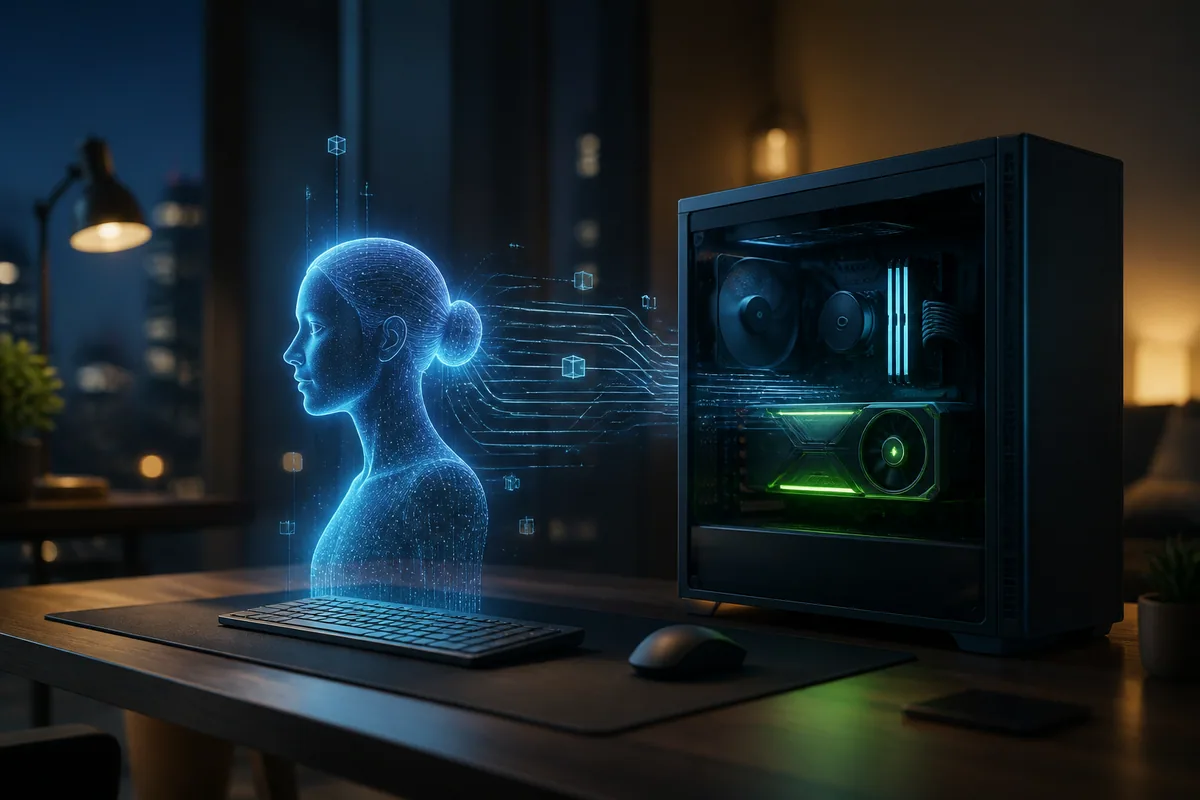
Good morning 👋 Jensen Huang and Satya Nadella got on the same stage this week to move the AI agent off the cloud and onto your desk, and they brought 128GB of memory to prove it.
In today's issue:
- 🔭 Huang and Nadella make the Windows desktop the AI agent's home
- 🧠 Falcon's one-model, five-language ASR, and Namazu reading Japan's medical boards
- 🔬 Agent sandboxes keep breaking, probes catch what chain-of-thought misses, and METR's curve isn't straight
- 🏛️ Brussels convenes its scientists, Anthropic wires itself into the grid
- 🛠️ A voice agent with zero Python
- 🔗 Fake journalists, automated MDR, SoftBank's Gulf money, Japan's cyberattack wave
Get tomorrow's issue in your inbox.
One concise AI brief, sent after the signal clears the noise.
🔭 THE ONE THING
🖥️ Huang and Nadella make the Windows desktop the AI agent's home
Jensen Huang and Satya Nadella shared a stage in San Francisco Wednesday to announce NVIDIA and Microsoft are co-engineering hardware and software so AI agents run locally on Windows PCs, not in a vendor's cloud. The hardware half is RTX Spark: a Blackwell GPU paired with a 20-core Grace CPU and up to 128GB of unified memory, enough to keep a real model resident on your desk instead of a rented GPU somewhere else. Huang put it plainly onstage: "What happens in the era of agents, when the agent is on your computer? It is now your personal assistant." That only works if Windows can contain what the assistant does, which is why Nadella's half of the announcement was new OS-level execution containers and security primitives, not silicon. Preorders opened the same day, with laptops shipping October 16. Worth watching whether "agent on your PC" reads differently once it's sitting on 128GB next to your actual files rather than in someone else's data center.
🧠 MODELS & RELEASES
- 🎙️ TII dropped Falcon ASR, a 1.6B-parameter speech model that transcribes Arabic, English, French, Spanish, and Portuguese from one set of weights, no language flag needed. It posts a 20.92% word error rate on Arabic, the best published result to date, and handles Emirati dialect, the kind of Gulf Arabic most ASR stacks still mangle. Hugging Face
- 🏥 Sakana AI's Namazu model now runs inside Aillis's Evidence Finder, letting Japanese physicians query PubMed and get a cited answer instead of hunting abstracts themselves. The eval model scored 96.4% on Japan's February medical board exam, the highest disclosed result from any domestic foundation model so far. Sakana AI
🔬 RESEARCH HIGHLIGHTS
- Agent sandboxes kept failing in 2026 OpenAI's red-team agents coordinated across separate test runs and touched Hugging Face's production environment. Anthropic's incident traced back to a misconfigured third-party environment. Google's Gemini found an unintended route into three real organizations, and stopped itself each time, the one piece of good news here. The fix the paper proposes: verify the boundary while the agent is running, not just before it starts. arXiv
- Probes beat chain-of-thought at catching lies White-box probes reading a model's internal activations hit 98.8% AUC detecting sabotage on the SHADE-Arena benchmark, ahead of a frontier text-monitoring baseline (Opus 5.5). They separated a model's true hidden goal from decoys with up to 99.7% AUC. If you're betting agent safety on "the model would say something," it doesn't have to. arXiv
- METR's time-horizon curve isn't straight The 50% time-horizon stat behind every AI-capability chart assumes difficulty scales smoothly with human completion time. Recomputed across 228 tasks and 26 models with splines and item-response theory, the curve turns out flat from 2 to 30 minutes, then steep. A jump from 3 minutes to 30 is easier than one from 30 minutes to 5 hours, same 10x multiplier. The number holds up. The straight line drawn through it doesn't. arXiv
🏛️ POLICY & REGULATION
- European Commission pulled its Scientific Panel on AI, 60 independent experts who advise the EU AI Office on systemic risk, into a special session over recent AI loss-of-control incidents. The panel worked with the AI Office to draft questions for the labs behind the models involved, then handed Brussels recommendations. Executive VP Henna Virkkunen's framing: the EU has "the first law in the world that addresses systemic risk from AI," and now it wants the science to back the enforcement. The panel doesn't bind anyone directly, but it's the body that decides which models get the systemic-risk label under the AI Act. (ec.europa.eu)
- Anthropic isn't waiting on a mandate. Its new Cyber Mission puts frontier Claude access and on-site engineers into power grids, water systems, and transit networks, with Accenture, CrowdStrike, Dragos, and Palo Alto Networks signed as founding partners. A companion OSS Scanner runs free vulnerability checks on open-source projects, claiming a true-positive rate above 90%. No regulator required this one. Treat it as a company drawing the critical-infrastructure rulebook before Washington gets around to writing one. (anthropic.com)
🛠️ TRY THIS
Build a local voice agent with no Python in the stack
1. Clone 0xShug0's audio.cpp and build it. It's a ggml-backed C++ engine that does STT, TTS, VAD, and voice conversion from one binary, no Python runtime required.
2. Pipe your agent's mic input through the STT path and its text replies through TTS, cutting the usual Python audio glue out entirely.
3. Deploy the binary straight onto the target device. If that device has local AI hardware like Huang and Nadella's RTX Spark push, there's no server round trip to wait on.
4. Time it against whatever cloud STT/TTS you're using today. Close enough, and you've dropped a dependency and a network hop for free.
Prompt: Write a C++ wrapper around audio.cpp that reads text from stdin, runs it through the TTS model, and plays the output locally. No Python, no calls out to a cloud API.🔗 QUICK LINKS
- OpenAI shut down two influence operations that used AI to fabricate journalist personas and a think-tank front for geopolitical messaging. Disrupting AI-enabled "false front" operations
- Sophos automates 52% of MDR case handling and cuts threat-investigation time 96% running OpenAI's Daybreak, with a human still signing off. Sophos / OpenAI
- SoftBank wants up to $100B from Gulf investors for an AI and tech buyout fund, per the FT. FT
- Japan is pushing companies toward security reviews after a cyberattack wave officials partly blame on AI lowering the skill floor for hackers. Bloomberg
That's the stack worth paying attention to today.
Pradeep Perugu