Anthropic ships a common driver for AI agents to run lab hardware
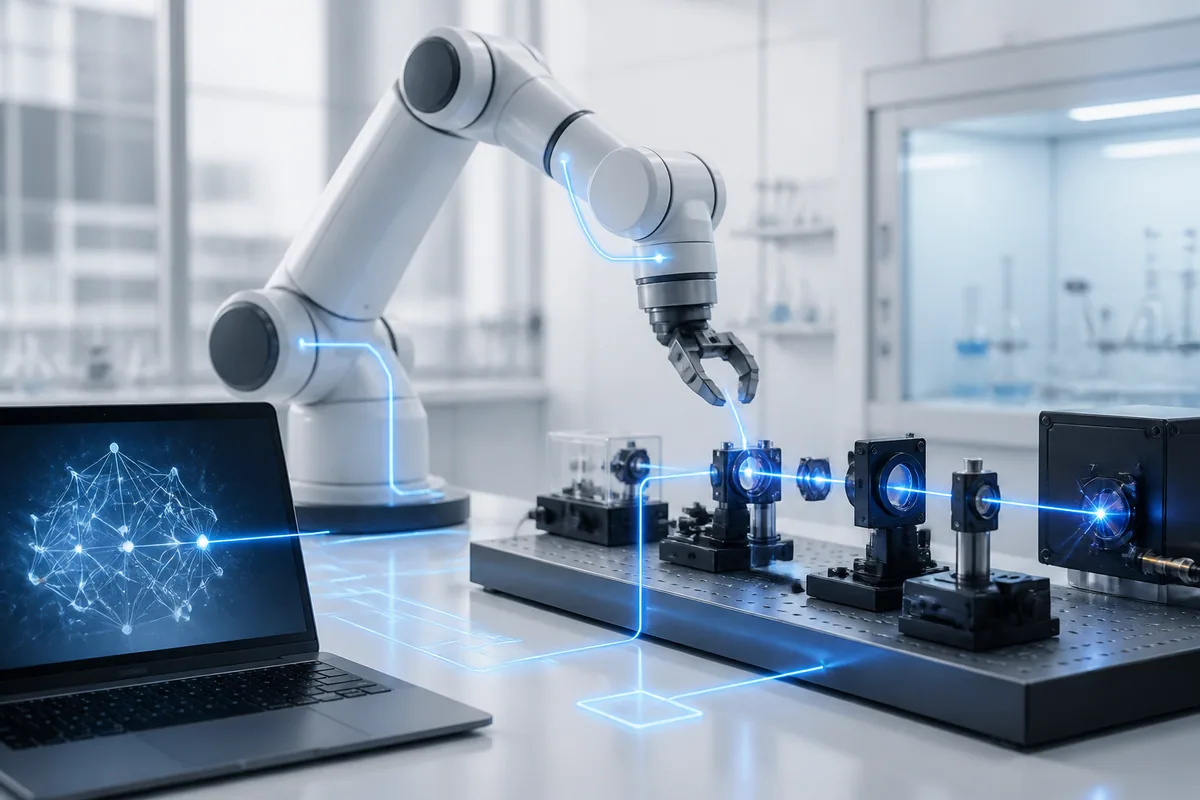
Good morning 👋 Anthropic wants Claude driving lab equipment now, not just chat windows. The number that should give you pause: eight hours to wire up hardware that used to take weeks.
In today's issue:
- 🔭 Anthropic ships a common driver for AI agents to run lab hardware
- 🧠 NVIDIA's efficiency claims and Gemini Omni's new video controls
- 🔬 Agent memory, evolving jailbreaks, and the geometry of machine morality
- 🏛️ FTC guts a fake "listening" ad scheme
- 🔗 OpenAI's cost-curve pitch, Redfin's court-ordered comeback
Get tomorrow's issue in your inbox.
One concise AI brief, sent after the signal clears the noise.
🔭 THE ONE THING
🦾 Anthropic ships a common driver for AI agents to run lab hardware
Anthropic opened a preview of the Model Hardware Standard, a spec that lets Claude read and write to physical equipment through the same "read"/"write" primitives it uses for software, with devices self-describing their own capabilities and safety limits over MCP, a CLI, or code. Carnegie Mellon says the spec cut hardware integration from weeks to eight hours; QuEra brought laser-recovery time from 150 seconds at 58% success down to six seconds at 96%. First users are scientific labs and manufacturers only, Genentech, UW's Baker and Pinglay labs, HHMI Janelia, Tetsuwan, running on gear from AWS, Danaher, and Universal Robots. Think driver layer, closer to USB-C than to anything that walks, but the ambition is plain: whoever standardizes how agents touch physical instruments first owns the plumbing everyone else builds on. Those numbers are Anthropic's own benchmarks, not independent ones, and "an LLM tunes your laser stabilization" is a claim worth a second look before it's a claim worth trusting with equipment you can't un-fire.
🧠 MODELS & RELEASES
- NVIDIA claims Vera Rubin NVL72 hits up to 30x the throughput per megawatt and 35x lower token costs than the GB300 generation, on SemiAnalysis's AgentX benchmark of real agentic coding sessions rather than synthetic prompts. Worth flagging: the numbers are still pending SemiAnalysis's own review, and NVIDIA says they don't yet count Vera's CPU side for tool calling. Up to 30x More Work Per Watt
- Google DeepMind shipped Gemini Omni 1.1 Flash with actual developer knobs on video generation: keyframe control to pin start and end frames, a 360p draft mode that's 60% faster and a third the cost of 720p, and scene extension chaining clips out to 40 seconds. Adobe, Figma and Runway are already integrated. Build with Gemini Omni 1.1 Flash
- NVIDIA also unveiled NVLink Fusion, letting partner XPUs from Intel, MediaTek and Amazon's Annapurna Labs plug into a 72-chip NVLink domain instead of a bespoke stack. The pitch is factory economics, tokens per watt and cost per token, but the only hard number in the post (GB300's 10x edge over B300) is leftover from the last launch, not this one. How XPUs Meet a World-Class AI Factory
🔬 RESEARCH HIGHLIGHTS
- Skills need a shared memory. Most agent-skill setups discover a trick, use it, and lose the reasoning behind it once the run ends. WikiSkill instead keeps a running wiki that separates raw execution logs from distilled knowledge from the skills themselves, so each new skill update can build on what the last one learned instead of starting cold. The result worth noting: a small model armed with evolved skills can beat a much bigger model without them, and skills built by one model transfer cleanly to another. That's the argument for treating agent memory as its own persistent layer, not a cache that gets wiped between tasks. arXiv
- Red-teaming that levels up. RedEvoAgent automates jailbreak attacks against agentic systems, the kind with tool access and state that persists across turns, which is a bigger blast radius than a chatbot saying something bad. It distills successful attack runs into a reusable "attack skill," then applies what the authors call a validation ratchet, keeping only updates that measurably improve the attack rate and discarding the rest. Static red-team suites test yesterday's exploits. This one keeps generating new ones. If you're shipping an agent with tool permissions, that's the adversary you should assume you're up against. arXiv
- Do models actually represent morality, or just detect it? Researchers trained six linear probes, one per moral foundation (care, fairness, liberty, loyalty, authority, sanctity), on open-weight models and found the directions are nearly independent of each other but share a common "this is a moral question" signal, distinct from other abstract concepts (0.26 cosine similarity versus 0.013 for matched controls). That structure shows up early in training, before the probes even get accurate at their job. The sharper finding: represent a genuine moral dilemma, and the model's internal direction is a real blend of the competing foundations, not a pre-baked answer dressed up as reasoning. For anyone doing interpretability-based alignment work, that's a concrete handle to grab. arXiv
🏛️ POLICY & REGULATION
- FTC finalized orders against Cox Media Group and two smaller firms, MindSift and 1010 Digital Works, for selling an "Active Listening" ad product that claimed to target ads off conversations your phone picked up. It didn't listen to anything. The agency says CMG was buying email lists from data brokers, marking them up, and selling the AI story on top. CMG pays $880,000, the other two $25,000 each, total $930,000. All three are now permanently barred from claiming voice-data collection or consumer consent they don't have, the FTC's first case built specifically around fake audio-surveillance ad claims. FTC order
🔗 QUICK LINKS
- OpenAI CFO Sarah Friar's pitch: chips, compute, models, and product all compound on the same cost curve, which is why intelligence keeps getting cheaper per unit. The full stack behind abundant intelligence
- FTC closes its Zillow-Redfin fight with a stipulated order. Redfin has to re-enter the internet-listing market it had agreed to sit out of. FTC press release
- OpenAI is building out Brazil: developer programs, business partnerships, community reach. Expanding OpenAI's presence in Brazil
- OpenAI ChatGPT for Teachers reaches 55 more U.S. school districts, over 100,000 additional educators and staff now covered. Bringing ChatGPT for Teachers to more U.S. school districts
That eight-hour number is the one worth remembering the next time someone tells you physical AI is still years off.
Pradeep Perugu