Higgsfield closes $400M at $5.4B, and AI video just out-earned the chatbot crowd
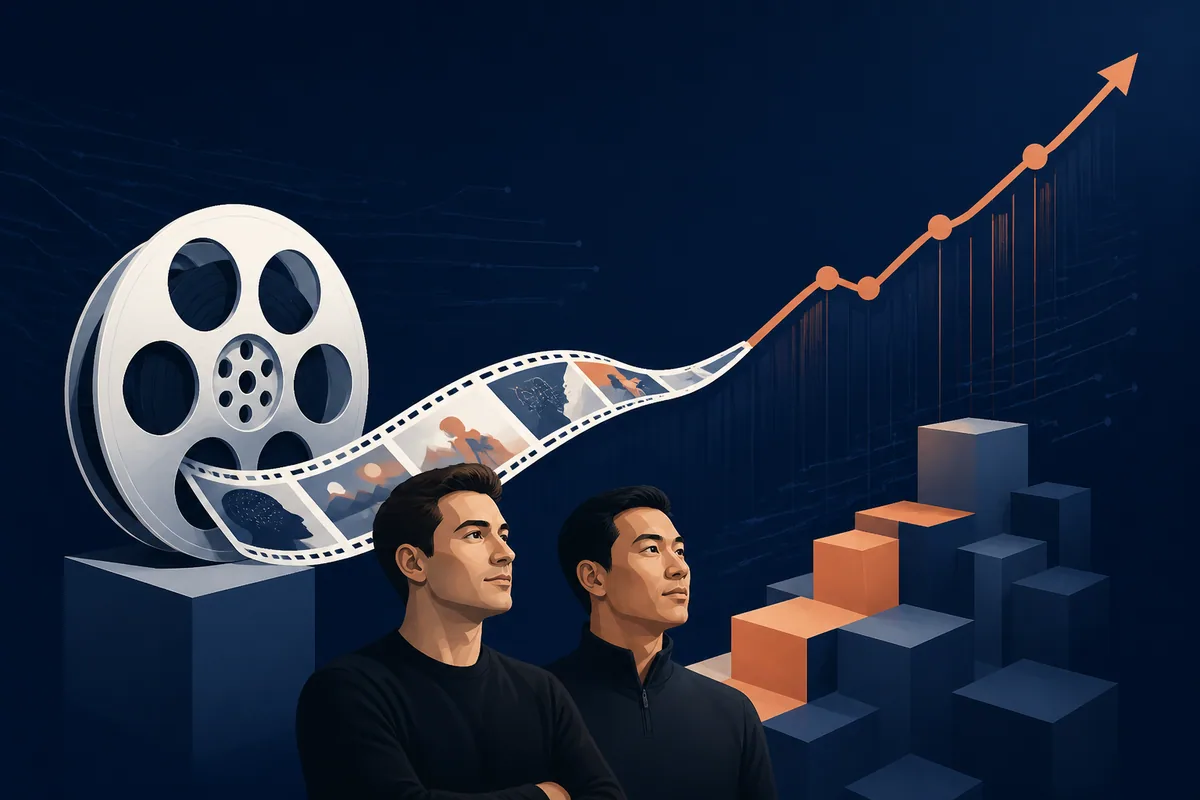
Good morning 👋 Higgsfield just quadrupled its valuation in seven months, and the number attached to it says video generation, not chat, is where AI revenue is actually landing.
In today's issue:
- 🎬 Higgsfield closes $400M at $5.4B, out-earning the chatbot crowd
- 🧠 Models & Releases: Claude's invisible watermark, a 27B open agentic model, Gemini goes to the match
- 🔬 Research Highlights: an agent that writes its own game manual, and why wrong answers still help
- 🛠️ Try This: run a batch video-ad test the way Higgsfield's customers do
- 🔗 Quick Links: a fund built to bankroll AI compute
Get tomorrow's issue in your inbox.
One concise AI brief, sent after the signal clears the noise.
🔭 THE ONE THING
🎬 Higgsfield closes $400M at $5.4B, and AI video just out-earned the chatbot crowd
Higgsfield closed a $400M Series B led by DST Global, pushing its valuation to $5.4B. That's four times the $1.3B mark it hit seven months ago. Goldman Sachs Alternatives, Intel Capital, Fifth Wall, Accel, and Menlo Ventures all piled in behind founders Alex Mashrabov, who built AI Factory before Snap bought it, and Mahi de Silva. The company says annualized revenue just hit $700M. That's Higgsfield's own number, not an audited one, and self-reported ARR at this velocity is exactly the kind of figure that gets quietly restated a year later. Even halve it, and Higgsfield is still one of the fastest-scaling AI companies alive right now. Proof that video generation, not chatbots, is where the biggest revenue numbers in AI are actually showing up.
🧠 MODELS & RELEASES
- 🔏 Anthropic rolled out invisible watermarks on Claude's text output, swapping in "digits of pi" for dice rolls at each low-stakes word choice so the result reads identical but becomes checkable with the decoding key. The company says quality holds up in aggregate; critics counter that the specific output you get is not the one you'd have gotten without it, and Anthropic hasn't published enough detail for anyone to verify the no-impact claim independently. How Claude's text watermark works
- 🪶 Qwen (Alibaba) shipped a 27B vision-language model under Apache-2.0, native 262K context stretchable to 1M, with real agentic gains: 61.7 on SWE-bench Pro, 84.3% on OSWorld-Verified. Small enough to self-host, strong enough to run a computer-use loop. Qwen3.8-27B on Hugging Face
- ⚽ Google paired Gemini with Pixel phones for AI matchday features at five football clubs. Watch, don't act: this is marketing, not a model release. Get closer to the game with Gemini and Pixel
🔬 RESEARCH HIGHLIGHTS
- Twin (ARC-AGI-3). A coding agent writes its own executable world model at test time, then won't take an action until the model replays every observation seen so far. Playing the games blind, the base model scores 7.8%. With a self-written twin model it jumps to 93.3%, clears 23 of 25 games, and finishes 179 of 183 levels, beating human efficiency on 158 of the ones it completes. The paper's real finding: the world model was the easy part. Guessing the goal before any reward signal is still the hard problem.
- Context handover. What actually has to survive when an agent's context fills up, the app restarts, or a different agent picks up mid-task? This paper treats it as a compression problem with a provable floor: store decisions and hard constraints exactly, collapse repeated evidence into task-justified statistics, keep only the raw leftovers those statistics don't cover. For linear-regression-style tasks they get exact bounds on how much memory a clean handoff needs. Anyone building agents that survive a restart is doing this by instinct already. Now there's a formalization to check it against.
- Wrong but useful. Multi-agent pipelines usually drop low-confidence or incorrect messages before a final answer gets assembled. Across five math and science benchmarks and two model families, this paper finds that's leaving value on the table: of the wrong-answer messages that end up changing a final result, more than four in ten change it for the better. A bad number can still carry a good decomposition. Filtering on correctness alone throws that away.
🛠️ TRY THIS
Run a batch video-ad test this week, the way brands scaling on Higgsfield already do
1. Pick one product or offer and write three hook variants: pain point, social proof, urgency.
2. Turn each hook into a 15-second shot list (open, product beat, CTA), one row per variant.
3. Feed the shot lists into an AI video generator's batch mode and render all three at once.
4. Run them 48 hours, kill whichever two don't move CTR, and iterate the shot list on the survivor.
Prompt: Write 3 alternate 15-second video ad hooks for [product], each opening with a different angle (pain point, social proof, urgency), followed by a one-line shot list for each.Worth a look
- GenOffice Free, Apache-2.0 office suite (Word, Excel, PowerPoint, PDF, Markdown) with AI agents built into the documents, not bolted on as a chat sidebar. It round-trips .docx/.xlsx/.pptx byte-for-byte, so Word never flags the file as touched. Solid for building the briefs and shot-list sheets above without a Microsoft 365 seat. genspark-ai/genoffice
🔗 QUICK LINKS
- Aegis Special Situations Fund filed a Form D for a new series, Series AI Compute I, a private vehicle raising capital specifically to bankroll AI compute deals. Filing
See you tomorrow.
Pradeep Perugu