NVIDIA Just Put a Supercomputer Inside a Navy War College
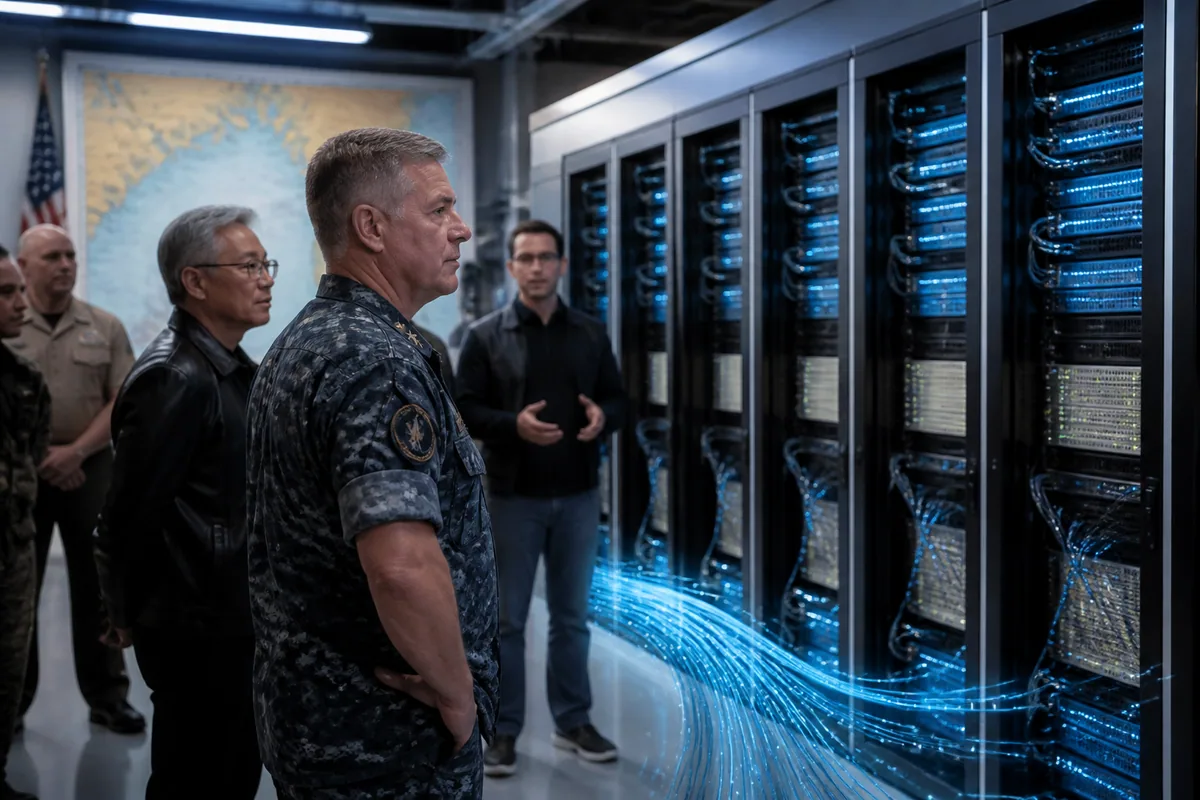
Good morning 👋 The Navy just got a free NVIDIA supercomputer, and "free" is doing a lot of work in that sentence.
In today's issue:
- 🔭 NVIDIA donates a supercomputer to a Navy war college, and a foothold in defense budgets along with it
- 🧠 monday.com's coding agents post real production numbers, OpenAI builds its own data center campus
- 🔬 Sakana's unverified cyber benchmark claim, and an alignment eval that ditches Western defaults
- 🏛️ Brussels road-tests GenAI in government, FTC mails out deception refunds
- 🛠️ Wire your coding agent straight into the database over MCP
Get tomorrow's issue in your inbox.
One concise AI brief, sent after the signal clears the noise.
🔭 THE ONE THING
⚓ NVIDIA Just Put a Supercomputer Inside a Navy War College
NVIDIA and the Naval Postgraduate School flipped the switch on a DGX GB300 system yesterday, with Jensen Huang and INDOPACOM commander Adm. Samuel Paparo on hand for the launch. It's the first DGX GB300 running inside the U.S. military, donated rather than sold through a procurement contract, serving the school's 1,500-plus students and 600 faculty on work spanning weather prediction to cyber defense. Call it what it is: NVIDIA seeding the Pentagon's AI stack for free, the same play cloud vendors ran on universities a decade ago, except the payoff here is a foothold in defense budgets worth a lot more than one donated rack. Whether it moves past ribbon-cutting into something INDOPACOM actually runs on is the part worth watching.
🧠 MODELS & RELEASES
- 🤖 monday.com is running AI Teammates, agentic coders built on Amazon Bedrock, across its whole engineering org: nine in ten Builders now use AI coding tools monthly, up from roughly half a year ago, and per-engineer PR throughput is up more than 50%. That's a rare case of an agentic coding rollout with real production numbers attached, not a vendor demo. AWS
- 🏥 NVIDIA open sourced its first GPU-accelerated medical physics simulation framework, part of Isaac for Healthcare, so surgical robot developers can simulate anatomy contact and sensor noise before touching hardware. J&J MedTech and CMR Surgical are already feeding it real clinical data, and NVIDIA's own benchmark shows 8,192 parallel training environments cutting a five-hour run to under two minutes. NVIDIA
- 🏗️ OpenAI is self-building its first data center campus: a $20B, 3.2GW site in Effingham County, Georgia, dubbed Project Camellia, with power delivered in phases through 2032. The $71M in Codex credits for local students is the nice line; the real signal is OpenAI moving off rented Microsoft and Oracle capacity and building its own. OpenAI
- 📰 OpenAI renewed its local-news bet, another $5M plus $3M in tech credits to the American Journalism Project, and opened an AI Academy for newsrooms built with the Lenfest Institute. The use cases showing up are specific: journalist copilots, translation, audience forecasting, not chatbots bolted onto a homepage. OpenAI
🔬 RESEARCH HIGHLIGHTS
- Fugu-Cyber Sakana's follow-up to the orchestration model that already beat frontier AI on cybersecurity benchmarks. The new version claims parity with purpose-built cyber models like GPT-5.5-Cyber and Mythos Preview. The claim is Sakana's own, straight off a tweet, no third-party eval yet. Watch, don't act: cyber benchmarks are easy to game with in-distribution test sets, and the first Fugu's numbers took weeks to get independently checked. link
- LKValues Every value-alignment benchmark you've heard of encodes Western defaults, so a model tuned to score well on them can still get local social norms wrong on the next question. This paper builds a benchmark from Sri Lankan context instead of translating an existing one. Builder read: if you're shipping outside the US and EU, your alignment eval probably doesn't cover the market you're shipping into. link
- Lipschitzian SLLNs is pure probability theory: a proof that strong laws of large numbers hold for locally Lipschitz random functions, under conditions broader than the usual o-minimal setup. No model, no benchmark, just the proof. It's the kind of foundational math that might tighten generalization bounds someday, not something you'll touch this quarter. link
🏛️ POLICY & REGULATION
- EU Commission is kicking off three GenAI pilots for public administration, with an Apply AI stakeholder meeting set for September 14. No binding rule here, just Brussels road-testing generative AI in government before it writes the next round of rules around it. Worth a bookmark if you sell into EU public sector. Kick-off details
- FTC mailed 9,419 refund checks, $672,000 total, to consumers deceived by Trend Deploy's marketing under operator Frank Romero. Recipients have 90 days to cash them before the money reverts. Press release
🛠️ TRY THIS
Wire an agent straight into your database before you burn a slot on shared compute
More GPU hours landing this week (Naval Postgraduate School just brought its NVIDIA cluster online) doesn't help if your training data is still a pile of ad hoc SQL exports. Fix that part locally, before the job queues.
1. Point dbx at a dev copy of your database (Docker or the desktop build, either works).
2. Turn on its built-in MCP server instead of opening a query GUI.
3. Connect your coding agent (Claude Code, Cursor, whatever you run) to that MCP endpoint.
4. Have the agent draft and dry-run the extraction query against the real schema, then check it by hand before the job hits shared hardware.
Prompt: Using the connected database via MCP, inspect the schema for the users and events tables, then write a query that joins them into a training-ready dataset covering the last 90 days of activity. Show me the query before running it.Worth a look
- dbx A 20 MB cross-platform client for 70+ databases (Postgres, MySQL, SQLite, Redis, Mongo, DuckDB, SQL Server, Dameng) with a built-in MCP server, so an agent queries your data directly instead of you pasting schemas into a prompt by hand. t8y2/dbx
That's the read for today. See you tomorrow.
Pradeep Perugu