Google's $1.5B bet on Alabama compute
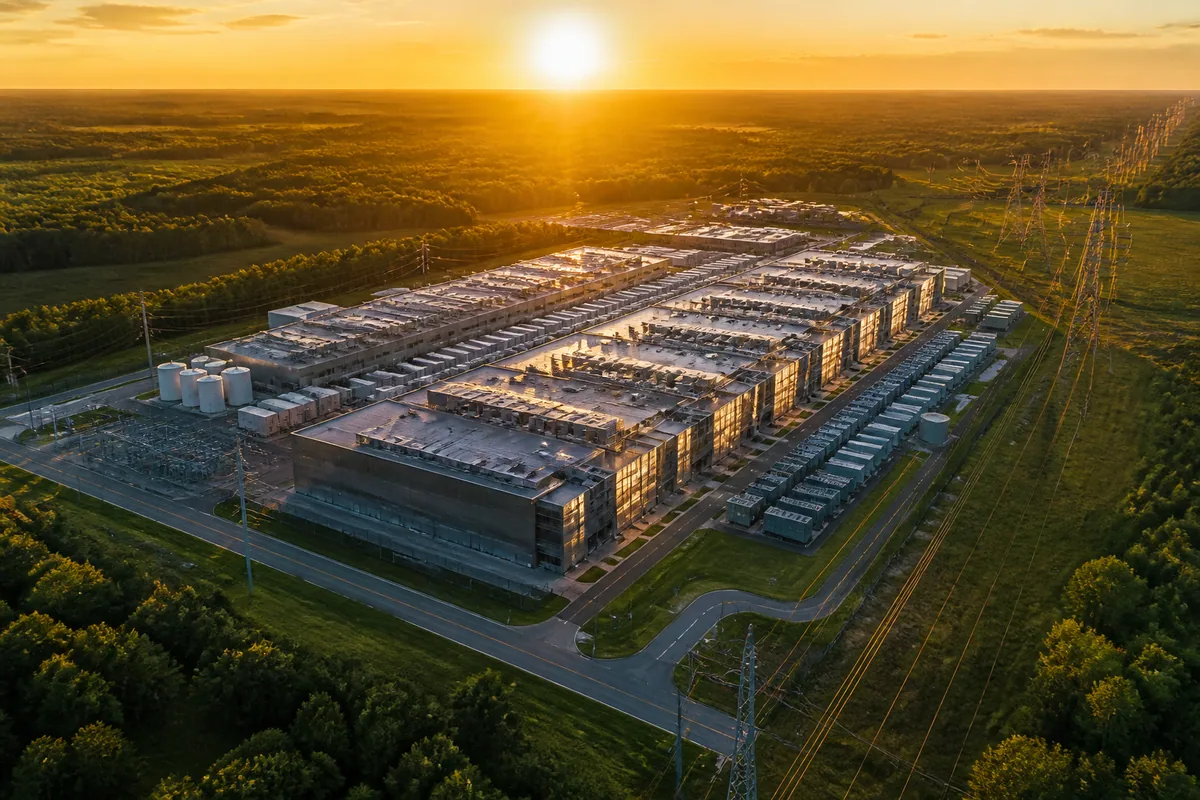
Good morning 👋 Google is putting $1.5 billion into Alabama. The AI infrastructure arms race keeps adding territory.
In today's issue:
- 🔭 Google's $1.5B Alabama data center push
- 🧠 Agent failure diagnosis gets structured, and AllenAI ships an eval workbench
- 🔬 When self-improving VLMs quietly regress, and reasoning for live data streams
- 🛠️ Agent debugging walkthrough + five trending tools
- 🔗 Quick links: isolated agent execution and an inside-out AI transformation
Get tomorrow's issue in your inbox.
One concise AI brief, sent after the signal clears the noise.
🔭 THE ONE THING
🏗️ Google's $1.5B bet on Alabama compute
Google announced $1.5 billion in investment across 2026 and 2027 to expand its Jackson County, Alabama data center campus. The site has been operating since 2019 on a repurposed former facility. This rounds out capacity on existing infrastructure, not a greenfield location.
The dollar figure is eye-catching, but the pattern behind it matters more. Amazon, Microsoft, Google, Meta, and SoftBank are all actively pouring money into physical compute before demand outpaces supply. Every model at scale needs somewhere to run. That somewhere increasingly looks like a repurposed industrial campus in the American South.
For founders and builders the direct effect is indirect: more regional capacity coming online, continued hyperscaler competition for cloud workloads, and downward pressure on inference costs over the next 18 months.
🧠 MODELS & RELEASES
- 🔍 AWS Strands Evals published a walkthrough for diagnosing real agent failures. The output is structured: categorized failure types with confidence scores, causal chains from root cause to downstream symptom, and fix recommendations. It's what most builders were doing manually with logs. Now it's a library call.
- 📊 AllenAI released olmo-eval, an evaluation workbench designed for iterative model development. Most eval tooling is built for final models. This one runs benchmarks across training checkpoints. If you're fine-tuning or running a model dev loop, worth a look.
🔬 RESEARCH HIGHLIGHTS
- When verifiers backfire. A paper out today shows that verifier-driven self-DPO, the standard recipe for self-improving production VLMs, can cause regression on tasks outside the verifier's training distribution. Scores go up on seen tasks while performance quietly drops on unseen ones. If you're running RLVR-based self-improvement in production, this is the failure mode to test before your next rollout.
- Reasoning for live inputs. AdaSR proposes a model that reasons as context arrives rather than after the full input is in. The target: live audio, video streams, continuous sensor feeds. Still a research paper, but the problem it names ("read-then-think doesn't fit dynamic input") is exactly the gap real-time agent work keeps running into.
🛠️ TOOLS & HOW-TO
Debug your agent before your users do
1. Add structured logging around every tool call: what was called, what came back, and whether the agent acted on the result in the next step.
2. Run Strands Evals against a replay of real failures from those logs.
3. Look for causal chains, not just the point of visible failure. Root causes are usually earlier in the trace than where things broke.
4. Gate on confidence: if the agent's internal score for a step falls below your threshold, surface it rather than letting it proceed silently.
Prompt: You are an agent evaluator. Given this tool-call trace: [TRACE], identify the earliest point of failure, the root cause, and whether the agent should have paused before reaching it. Output JSON: {failure_point, root_cause, fix_recommendation, confidence_score}5 trending right now
- 📚 ai-engineering-from-scratch. Zero-to-production AI engineering curriculum, free and actively updated. link
- 🌐 ai-website-cloner-template. Clone any website with one agent prompt; useful base for scraping and UI prototyping. link
- 🏗️ learn-harness-engineering. 0-to-1 tutorial on building agent harnesses, aimed at beginners. link
- ⚡ nullclaw. Autonomous AI assistant infrastructure in Zig: tiny binary, no dependencies, fast startup. link
- 📂 OfficeCLI. Free, open-source CLI for reading and editing Word, Excel, and PowerPoint files, purpose-built for AI agents. No Office installation required. link
🔗 QUICK LINKS
- AWS Bedrock AgentCore. New tutorial for building competitive research agents using Deep Agents with isolated execution environments. Good reference architecture for multi-step workflows that need sandboxed agent contexts.
- AWS ProServe. How AWS Professional Services rebuilt its own delivery model with frontier AI: engagement timelines from months to days, not by layering tools on top of old processes but by redesigning from scratch. Useful reading for operators thinking about AI transformation the right way.
See you tomorrow.
Pradeep Perugu