OpenAI is buying Ona to make Codex agents run for hours, not minutes
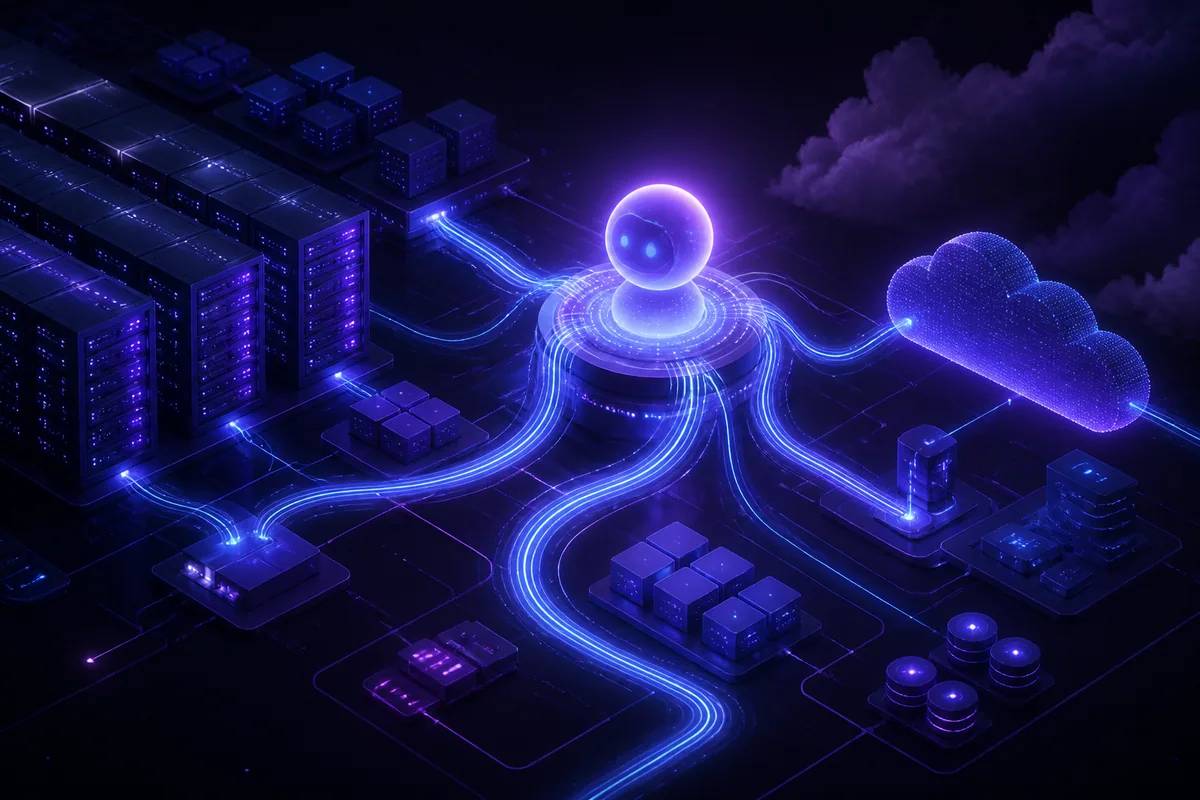
Good morning 👋 OpenAI just bought its way toward agents that run for hours, not minutes. The day's other news is quietly about the same thing: making AI durable, local, and accountable.
In today's issue:
- 🔭 OpenAI acquires Ona to give Codex persistent cloud environments
- 🧠 Models & releases: DeepMind's DiffusionGemma, Codex in the lab
- 🔬 Research highlights: beating attention's quadratic cost, production Text-to-SQL
- 🏛️ Policy & regulation: the EU's AI-labelling code, a NIST security proof
- 🛠️ Tools & how-to: trim your agent's token bill this week
- 🔗 Quick links: robotaxi safety, Oracle, agent evals
Get tomorrow's issue in your inbox.
One concise AI brief, sent after the signal clears the noise.
🔭 THE ONE THING
🤝 OpenAI is buying Ona to make Codex agents run for hours, not minutes
What happened: OpenAI announced it plans to acquire Ona to expand Codex with *secure, persistent cloud environments* for long-running AI agents across enterprise workflows (OpenAI). Deal terms weren't disclosed in the announcement.
Why it matters: Coding agents today mostly run ephemeral, short tasks: spin up, do a thing, tear down. The hard part of real enterprise work is *durability*: an agent that can hold state across a long, multi-step job and survive a failure mid-run. Buying persistent-environment infrastructure signals the coding-agent race is shifting from "can it write the code" to "can it run reliably inside your stack for hours."
The takeaway: Watch whether "agents that persist" becomes the next battleground. It's the gap between an impressive demo and something a team actually ships on.
🧠 MODELS & RELEASES
- 🧩 Google DeepMind released DiffusionGemma, a diffusion-based variant of Gemma that it says generates text ~4× faster than standard autoregressive decoding (DeepMind). NVIDIA published a companion guide on running it locally on RTX hardware (NVIDIA). A rare cross-lab signal that diffusion text models are moving from research toward on-device use.
- 🔭 OpenAI showed a concrete science use of Codex: an astrophysicist using it to build black-hole simulations and test general relativity (OpenAI). Coding agents as a research instrument, not just a dev tool.
🔬 RESEARCH HIGHLIGHTS
- Doc-to-Atom: Compiling and Composing Memory Atoms. Proposes turning long documents into reusable "memory atoms" so models sidestep attention's quadratic cost in multi-turn reasoning, cutting the memory and latency tax on long contexts (arXiv).
- TAHOE: Text-to-SQL with Automated Hint Optimization. Tackles why Text-to-SQL prototypes fail in production by auto-tuning query hints from past runs to handle strict SQL dialects at scale (arXiv). Useful reading if you're putting natural-language-to-DB anywhere near real data.
🏛️ POLICY & REGULATION
- 🇪🇺 European Commission published the final Code of Practice on marking and labelling AI-generated content, the operational guidance behind the AI Act's transparency obligations (EU Commission). If you ship generative features into the EU, watermarking/labelling is moving from "nice to have" to expected.
- 🏛️ NIST released a mathematical proof, extending the logic of Gödel's incompleteness theorems, supporting a shift to a *continuous-monitor-and-update* security model for AI systems, rather than one-time certification (NIST).
🛠️ TOOLS & HOW-TO
Trim your coding agent's token bill this week
1. Audit one recurring agent task and note its average tokens per run.
2. Strip restating context the model already has in scope: terse instructions, no re-pasting files.
3. Wrap the task in a reusable skill/preset so the lean version is the default, not a one-off.
Prompt: Rewrite the following agent instruction to be as terse as possible without losing any requirement or constraint. Output only the rewritten instruction.5 trending right now (GitHub, by recent momentum)
- 🪨 caveman: a Claude Code skill that cuts ~65% of tokens by phrasing prompts in terse "caveman" style (GitHub).
- 🧠 mempalace: an open-source, benchmarked AI memory system for agents (GitHub).
- 🦀 zeroclaw: small, fully autonomous personal-assistant infrastructure that deploys across any OS/platform (GitHub).
- 🎨 taste-skill: a skill that pushes models away from generic, boilerplate "slop" output (GitHub).
- 🧰 openclaude: a portable, model-agnostic coding-agent runner (GitHub).
🔗 QUICK LINKS
- NVIDIA argues robotaxi safety must be designed in from the start, detailing its HALOS approach as driverless services scale (link).
- OpenAI made its models and Codex available through Oracle Cloud commitments, more enterprise distribution for its agents (link).
- AWS open-sourced Agent-EvalKit for evaluating AI agents systematically, handy if you're trying to measure agent reliability (link).
That's a wrap. Build on. — inovAIte
How was today's issue? 😍 / 🙂 / 😴